

Understanding the legal boundaries of self-defense tools is critical before you carry or rely on any form of personal protection device. That includes firearms, pepper spray, and the growing category of less-lethal defense tools like pepper ball guns.
Recently, Bill Kirk of the popular YouTube channel Washington Gun Law published a video examining how pepper ball launchers fit within the broader legal framework of self-defense. Kirk, an attorney who regularly analyzes firearm and self-defense law, discusses where these devices may fall on the spectrum between traditional firearms and non-lethal personal protection tools.
Prepared2Protect is sharing the video because it highlights important considerations many people overlook when evaluating personal defense options. The discussion below summarizes key points from the video while providing additional context on pepper ball guns, less-lethal defense tools, and responsible use.
Note: The commentary referenced in this article reflects Bill Kirk’s interpretation of legal concepts based on his experience. It should not be considered legal advice. Laws governing self-defense tools vary by state and locality. Individuals should review their own state laws or consult qualified legal professionals for guidance.
What Is a Pepper Ball Gun?
A pepper ball gun is a launcher designed to fire small projectiles filled with powdered capsaicin, the active ingredient in pepper spray. When the projectile breaks on impact, the powder disperses, causing intense irritation of the eyes, skin, and respiratory system. Pepper ball launchers were originally developed for law enforcement and crowd control, but in recent years, they have become more widely available for personal defense.
Unlike traditional firearms, pepper ball guns are designed to stop or deter an attacker without causing permanent injury or lethal trauma in most circumstances. That places them in the category often referred to as less-lethal self-defense tools. The term “less-lethal” is important. It means the device is designed to reduce the likelihood of fatal outcomes, but it does not mean the device is entirely risk-free. Any defensive tool that launches a projectile still requires responsible use and awareness of legal boundaries.
The Self Defense Spectrum
In his video, Bill Kirk discusses a concept that often appears in self-defense law: the spectrum of force. At one end of that spectrum are minimal force options such as:
-
Verbal commands
-
Physical disengagement
-
Pepper spray or gel
At the other end of the spectrum lies lethal force, typically involving firearms. Pepper ball launchers occupy a middle ground between these extremes.
As Kirk explains in the video, devices that fire projectiles but are designed to incapacitate rather than kill can be seen as part of an intermediate force option. For some people, this middle category can provide a defensive tool that offers greater reach and deterrence than a handheld spray.
However, the legal standard for using force in self-defense still applies regardless of the tool used. According to longstanding legal principles reflected in many state statutes, force used in self-defense must generally be reasonable and proportionate to the threat. Even if the device is less-lethal, using it in a situation where force is not justified could still create legal consequences.
Why Some People Choose Less-Lethal Defense Tools
Many individuals seek alternatives to firearms for a variety of reasons. Some live in areas where firearms ownership is heavily regulated. Others prefer tools that offer defensive capability without the potential consequences associated with lethal force. Less-lethal defense options such as pepper spray, stun devices, and pepper ball launchers can offer several advantages.
Reduced Risk of Permanent Harm
Pepper-based defensive tools rely on capsaicin irritation rather than ballistic trauma. The goal is to overwhelm an attacker’s senses long enough to allow the defender to escape and reach safety.
Greater Distance Than Traditional Spray
One challenge with traditional pepper spray is range. Most handheld sprays are effective at distances of roughly 10 to 12 feet, according to guidance from organizations such as the National Institute of Justice.
Pepper ball launchers can extend that range significantly. Many models are capable of reaching distances of 60 feet or more, giving the user additional space between themselves and a potential threat.
Deterrence
A launcher that resembles a firearm may also serve as a visual deterrent, potentially discouraging an aggressor before force becomes necessary. However, that resemblance also means users should exercise caution and awareness of how the device might be perceived.
Understanding Pepper Ball Launcher Ammunition
Not all pepper ball projectiles are identical. In fact, the versatility of these launchers comes from the variety of projectiles available.
Common types include:
Pepper balls
These contain powdered capsaicin that disperses upon impact, producing an intense burning sensation and temporary incapacitation.
Rubber impact rounds
These are solid projectiles designed to deliver a painful impact that can discourage or stop an attacker.
Marking rounds
These contain brightly colored powder used to mark individuals for identification.
The ability to switch between different types of ammunition allows users to tailor the launcher to different scenarios. For example, some individuals prefer kits that combine impact rounds and marking balls where pepper projectiles may be restricted.
Prepared2Protect offers options designed for both configurations.
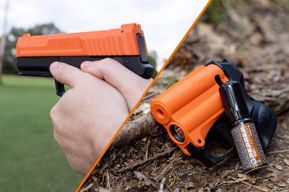
For example, the P2P Secure 68P Pepper Defense Kit includes a full-size launcher along with pepper rounds designed for defensive use.
For areas where pepper projectiles may not be allowed, the P2P Secure 68P Impact Defense Kit offers a configuration that includes rubber balls and marking rounds instead.
Legal Considerations for Pepper Ball Guns
One of the most important points raised in Bill Kirk’s video is that less-lethal does not mean legally unrestricted.
Different states regulate self defense tools in very different ways. Some states treat pepper ball launchers similarly to paintball or air-powered devices, while others impose restrictions on the projectiles they can fire.
For example, certain jurisdictions restrict or prohibit pepper projectile ammunition, even though rubber or marking rounds may still be allowed.
California is one example where pepper ball launchers that fire chemical irritants face restrictions, though other non-pepper rounds may be permitted depending on configuration.
Because laws can change and may vary by city or county, it is important to review the specific regulations that apply where you live.
Reputable resources for understanding self defense laws include:
-
State statutes and legislative websites
-
Local law enforcement guidance
-
Legal analysis from organizations that specialize in firearms and self defense law
Kirk’s channel, Washington Gun Law, frequently examines these legal issues in detail, which is why his analysis has become widely followed among firearm owners and self defense enthusiasts.
Responsible Use and Training
Regardless of the tool chosen, responsible use is essential.
Less-lethal defense devices should never be viewed as a substitute for awareness, avoidance, and de-escalation strategies. Experts in personal safety consistently emphasize that the best self defense strategy is to avoid confrontation whenever possible.
Training and familiarity are also critical. Users should understand:
-
How their launcher functions
-
The effective range of the device
-
How projectiles behave upon impact
-
Safe storage practices
Even non-lethal tools require proper handling and situational judgment.
Pepper Gel as Another Personal Defense Option
Pepper ball launchers are not the only option for individuals seeking a less-lethal self defense tool.
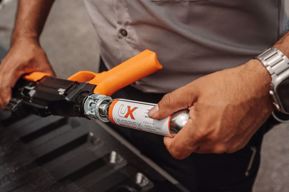
Pepper gel is another widely used defensive product that delivers concentrated capsaicin in a targeted stream. Unlike traditional aerosol sprays, pepper gel is thicker and less prone to blowback in windy conditions.
For individuals who prefer a compact defensive device, Prepared2Protect offers the P2P PGS II Pepper Gel Flashlight Defense Pistol. This compact launcher combines pepper gel delivery with an integrated flashlight, creating a portable tool designed for personal safety.
As with other pepper-based defense products, availability may be restricted in certain states or jurisdictions, so users should always confirm local regulations before purchasing or carrying.
The Role of Preparedness
Personal safety is ultimately about preparation and awareness. Tools like pepper spray, pepper ball launchers, and other less-lethal devices are only one component of a broader safety strategy.
Situational awareness, defensive training, and understanding local laws all play important roles in responsible self defense.
The discussion presented in Bill Kirk’s video highlights an important truth: the legal and practical aspects of defensive tools are rarely simple. Devices that appear straightforward on the surface may exist within complex legal frameworks that vary significantly from state to state.
By learning about these considerations in advance, individuals can make more informed decisions about the defensive tools they choose to carry.
Final Thoughts
Pepper ball guns represent a growing category of less-lethal self defense options that can offer range, deterrence, and versatility.
However, as emphasized in the analysis from Washington Gun Law, understanding how these tools fit into the legal landscape is essential. Even non-lethal devices must be used responsibly and within the bounds of local law.
For individuals exploring personal protection options, taking the time to research, train, and evaluate available tools is an important first step.
Prepared2Protect encourages responsible ownership, education, and awareness when it comes to personal defense. Resources like the video from Bill Kirk help highlight the broader legal context that every responsible user should understand.